

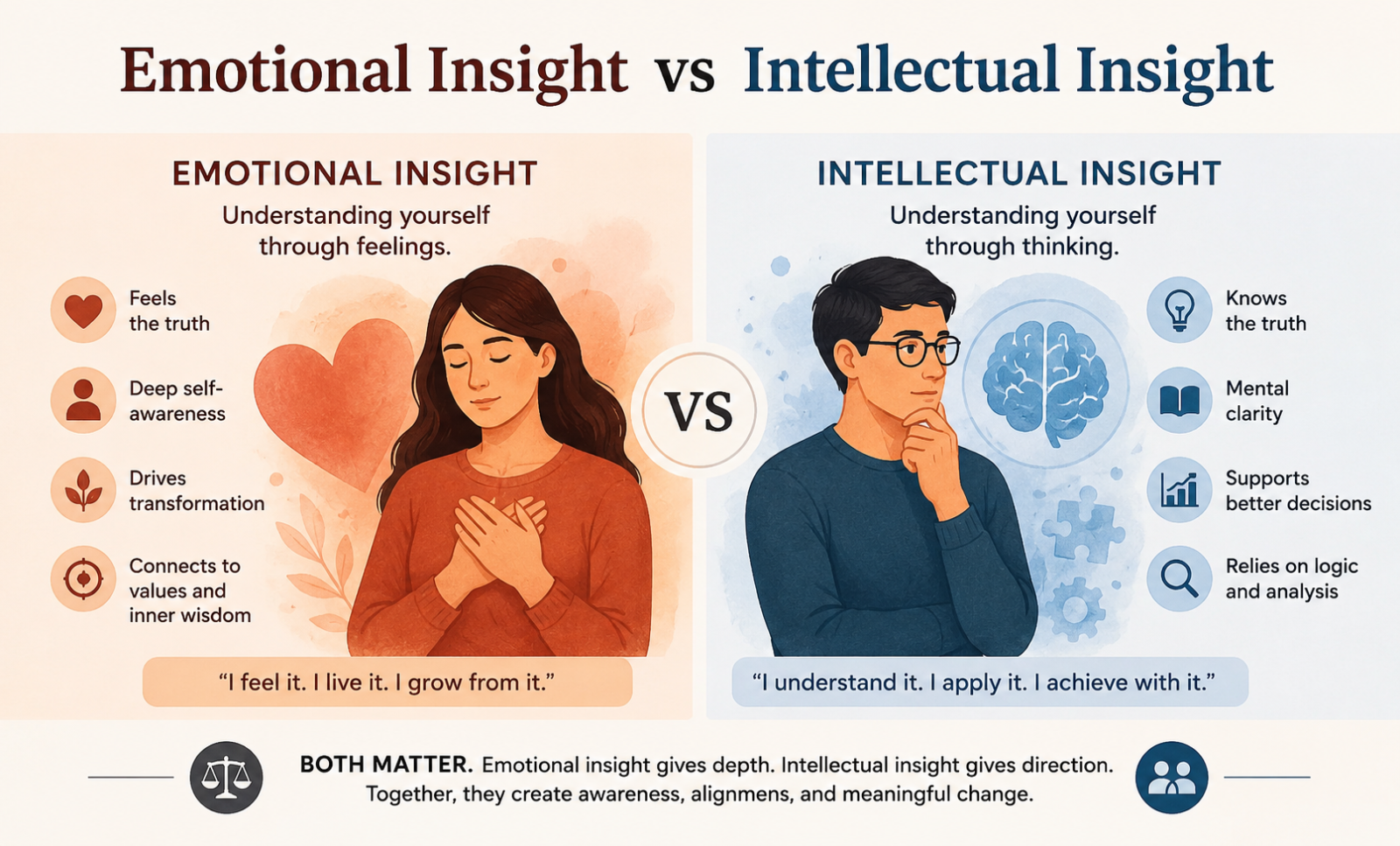
Many people enter therapy with a sophisticated understanding of their own psychological history. They can trace their anxiety to a specific childhood dynamic, analyze their relationship patterns, and detail exactly why they react the way they do. Yet, despite this high level of self-awareness, they often find that their actual emotional experience remains unchanged. They are stuck in a frustrating loop: they know exactly why they are suffering, but they still feel the same pain.
Intellectual insight is a cognitive achievement. It allows us to map our behavior, identify triggers & construct a logical narrative of our lives. While this is an important first step, intellectualizing can sometimes serve as a defense mechanism—a way of thinking about feelings to avoid actually feeling them. For those looking to understand how this process works in practice, learning about the principles of psychodynamic therapy can shed light on how therapist and client work together to access these deeper layers of the self.
Emotional insight, by contrast, is not merely about understanding a pattern; it is about experiencing it in the present moment. It is the shift from saying “I know I have abandonment issues” to actually feeling the raw, vulnerable fear of abandonment in the safety of the therapeutic relationship, and surviving it. While intellectual insight occurs in the mind, emotional insight is deeply embodied. It registers in the nervous system, allowing for a genuine reorganization of how we relate to ourselves and others.
The Limits of Thinking Our Way Out of Pain
Why is cognitive understanding alone often insufficient for lasting change? The answer lies in how our earliest memories and emotional habits are encoded. Much of our relational conditioning is implicit, stored in areas of the brain that govern emotion and bodily responses rather than language and logic.
When a child learns that expressing anger leads to withdrawal or punishment, that lesson is registered as a somatic survival strategy. In adulthood, the mere threat of conflict might trigger an automatic cascade of anxiety, muscle tension, or the urge to appease. A person can logically remind themselves that their current partner is safe, but their nervous system is still reacting. You cannot simply debate yourself out of a physiological defense state; you must have a different emotional experience to update the system.
The Role of Embodied Experience in Depth Psychotherapy
In depth-oriented and psychodynamic therapies, the focus shifts from talking about an emotion to experiencing the emotion as it happens. This requires a safe, attuned relational environment. When a client feels a wave of sadness or anger during a session, the therapist does not simply help them analyze it. Instead, they encourage the client to slow down, notice where the feeling lives in the body, and sit with the discomfort without rushing to fix it or explain it away.
This process of staying with the feeling allows the emotion to complete its natural cycle. It also provides what psychologists call a corrective emotional experience. When a person allows themselves to express a long-buried feeling—such as grief, rage, or deep vulnerability—and finds that the therapist receives it with warmth and without judgment, the old internal expectation is broken.
Integrating Head and Heart for Lasting Change
True healing is not about choosing feeling over thinking, but rather about integrating the two. Intellectual insight provides the map, but emotional insight is the journey itself. When cognitive clarity is paired with embodied emotional experiencing, deep structural change becomes possible. As these insights integrate, people often report a profound shift in their daily lives. Relational patterns that once felt rigid and automatic begin to soften. The constant self-monitoring and intellectualizing give way to a more spontaneous, authentic way of being. By allowing ourselves to feel our way through our difficulties, rather than just thinking our way around them, we open the door to genuine self-acceptance and lasting transformation.
