

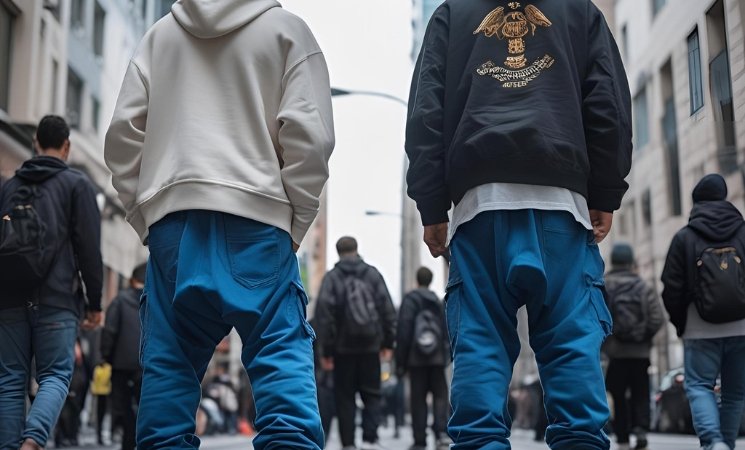
Sagging pants have been a lightning rod in American style for over three decades: banned by city councils, denounced from the campaign trail, and worn defiantly anyway. So why do people actually sag their pants? The honest answer involves a prison system, a hip-hop explosion, a wave of local laws that courts eventually struck down, and a 2020s twist nobody saw coming.
What Does Sagging Pants Mean?
Sagging means wearing trousers low enough on the hips that the waistband sits well below where a belt normally would, often exposing part of the underwear beneath. It’s a deliberate style choice, not an accident of fit, and it’s been documented on every populated continent since the 1990s.
Where Sagging Actually Came From
The most commonly repeated origin story traces sagging to the U.S. prison system, where belts are often prohibited as a self-harm precaution and ill-fitting standard-issue clothing tends to slide down. Formerly incarcerated men are said to have carried the look back into their neighborhoods, where it was picked up by hip-hop artists in the 1990s and turned into a mainstream style statement.
Fact-checkers at Snopes have confirmed the core of that story: sagging did begin in the U.S. prison system, driven by oversized standard-issue clothing and the lack of belts. What Snopes has debunked are the more sensational rumors that grew up around it online, various urban legends claiming deeper hidden meanings behind the style that don’t hold up to scrutiny. The boring, documented explanation is also the accurate one.
What’s not in dispute is the timeline: by the 1990s, rappers and hip-hop artists had made sagging a visible part of music videos and street fashion, and fans copied the look as a marker of coolness and identity.
Why Do People Sag Their Pants?
Once the style took hold, it kept spreading for reasons that go well beyond imitation. Researchers and journalists who’ve covered the trend point to a handful of overlapping motivations.
Cultural Influence
Hip-hop and rap artists popularized the look throughout the 1990s and 2000s, and fans copied their favorite artists, turning sagging into a visible symbol of the culture around the music.
Fashion Statement
Within streetwear, sagging reads as relaxed and confident. It’s a way to stand out, and for a stretch in the 2000s and early 2010s it was popular even among private-school and university students who wore it to show off designer underwear brands.
Peer Influence
Plenty of people who’ve sagged their pants have said, plainly, that they did it because everyone around them did. Surveys of teenagers in the UK in the early 2010s found many wore the style specifically to avoid standing out as uncool, which is peer pressure working in the opposite direction from how it’s usually described.
Rebellion and Identity
For some wearers, sagging is a quiet act of defiance against dress codes and adult expectations. That’s precisely why so many schools, cities, and transit systems tried to ban it: the rebellion was the point, for both the people wearing it and the people trying to stop them.
Comfort
Some wearers simply find a looser fit more comfortable. It’s a less dramatic reason than the others, but physiotherapists in Denmark and New Zealand who studied the trend in the 2000s found the style came with a real physical cost: an exaggerated, shuffling gait that some warned could strain the back over time.
The Bans, the Backlash, and the Politics
Sagging didn’t just draw eye-rolls from parents. It became a genuine local political issue across the United States during the 2000s and 2010s. Louisiana’s Delcambre passed an indecent-exposure ordinance against it in 2007. Georgia’s Hahira and Missouri’s Pagedale followed with their own clothing ordinances in 2008. Albany, Georgia, went further in 2010, fining first-time offenders $25 and repeat offenders up to $250 — and had collected nearly $4,000 in fines within a year.
Not every case held up in court. In 2008, a Florida court dismissed a similar prosecution on constitutional grounds, and civil liberties groups pushed back hard on the wave of bans. Benetta Standly of the ACLU of Georgia called the enforcement racial profiling, warning it would disproportionately target young Black men. In the UK, a 2010 attempt to slap an anti-social behaviour order on an 18-year-old for sagging was withdrawn after a judge ruled it would breach his human rights.
Even national politics weighed in. Speaking on MTV just before the 2008 U.S. presidential election, Barack Obama called laws banning the style “a waste of time,” while still adding: “Having said that, brothers should pull up their pants. You are walking by your mother, your grandmother, your underwear is showing. What’s wrong with that?”
The cultural pushback got its own viral moment in January 2010, when “General” Larry Platt performed his song “Pants on the Ground” during American Idol auditions, mocking the trend so memorably that it became a genuine pop-culture catchphrase almost overnight. By the late 2010s, several of the cities that had passed bans, including Shreveport, Louisiana, and Opa-locka, Florida, quietly repealed them.
Sagging Around the World
The trend spread far beyond the United States, and it didn’t always mean the same thing everywhere. In Denmark, sagging became popular among young middle- and upper-class men in the early 2000s specifically to imitate American rappers, and by 2009 an anthropologist described the resulting “waddling gait” as one of the decade’s defining cultural quirks. Swedish schools banned it from gym classes in 2007 over safety concerns after students struggled to move normally.
In the UK, the trend took hold among young people in the early 1990s who wanted to flash designer underwear brands like Calvin Klein, and by the early 2010s it was still described as “persistently popular” among teenage boys, including at private schools and universities. Australia saw a similar pattern, with private-school boys sagging to display branded underwear and a 2010 report describing the resulting bandy-legged walk as “the typical gait of the generation.”
The trend also produced real friction outside the West. In 2013, Hamas police in Gaza ran a campaign called “Pull Up Your Pants,” stopping young men on their way to school. In Japan, where the style is called koshipan, a 2010 survey found roughly 10 percent of students at most schools sagged their pants, and Olympic snowboarder Kazuhiro Kokubo was publicly disciplined by Japan’s ski federation for wearing sagging pants through the airport on his way to the 2010 Winter Olympics.
A Quick Timeline of the Trend
| Decade | What Happened |
|---|---|
| 1980s | The most-cited origin story: belts prohibited in U.S. prisons lead to naturally low-hanging pants (a claim later disputed by fact-checkers). |
| 1990s | Hip-hop artists popularize the look in music videos and street fashion; it spreads to the UK, Denmark, and Japan. |
| 2000s-2010s | Peak mainstream popularity, paired with a wave of U.S. city ordinances and school bans, and pushback from the ACLU and civil liberties groups abroad. |
| Mid-2010s | Decline begins as hip-hop fashion shifts toward tailored, fitted clothing. |
| 2020s | Sagging resurfaces: a Balenciaga fashion controversy, a documented rise among young women, and online communities revisiting the trend with nostalgia. |
| Late 2025 | Young Black designers (KidSuper, Trapstar London, Jawara Alleyne, Chopova Lowena) bring sagging to the runway, reframing it as reclamation rather than nostalgia. |
The 2020s Twist: Decline, Controversy, and Reclamation
Sagging faded from mainstream fashion through the mid-to-late 2010s as hip-hop style itself shifted toward tailored, well-fitted clothing. But it didn’t disappear, and the 2020s gave it a few unexpected chapters.
In 2021, luxury label Balenciaga released a $1,190 pair of sweatpants with fake boxer shorts sewn in to mimic the sagging look. Critics accused the brand of “gentrifying” a trend long associated with criminalizing young Black men, and the backlash became a genuine fashion-industry controversy over who gets to profit from a style with a complicated history.
More surprising was a shift reported by The Washington Post in 2023: sagging was catching on among young women, driven partly by a post-pandemic embrace of comfort over fit and partly by changing attitudes about gender and clothing. Around the same time, online communities of gay men in their 20s and 30s began revisiting the trend on social media as a shared piece of nostalgia from their teenage years, reframing a style once tied to hypermasculine posturing.
Sagging Hits the Runway in Late 2025
The trend took its most unexpected turn yet in November 2025, when The FADER reported that several young Black designers brought sagging directly onto the runway, explicitly reclaiming a look long associated with criminalizing young Black men. KidSuper designer Daveed Baptiste showed a minimalist take, pairing low-slung pants with chunky belts and chains. Trapstar London sent models out in doubled-up boxers for a layered underwear look, while designer Jawara Alleyne used briefs instead of the traditional baggy boxers, worn low enough to fully display them. Chopova Lowena applied the same idea to skirts, pairing pleated, low-slung pieces with ruffled bloomers cinched at each tier.
The framing from designers and critics covering the shows was explicit: this wasn’t nostalgia for its own sake, but fashion houses deliberately revisiting a style once used to stigmatize the communities that created it.
Is Sagging Still Popular Today?
Not in the way it was during its 2000s peak. Slim and tailored fits dominate mainstream fashion now, and by the early 2020s the style was considered “faded” even in cities like Philadelphia where it once defined a generation’s look. Streetwear and TikTok keep some version of it alive, often paired with luxury sneakers or oversized hoodies, but it’s a niche statement today rather than the dominant youth style it was two decades ago.
Frequently Asked Questions
Did sagging pants really start in prison?
Yes, according to Snopes. Oversized prison-issue clothing and a lack of belts (removed as a self-harm precaution) are the documented origin. Other, more sensational stories that circulated online about hidden meanings behind the style have been debunked as urban legends.
Is it illegal to sag your pants?
No U.S. state or federal law bans it, but several individual cities passed local ordinances against it in the 2000s and 2010s, some carrying fines up to several hundred dollars. Courts have struck down at least one such law as unconstitutional, and a number of cities have since repealed their bans.
Why do schools ban sagging pants?
Most school dress codes cite it as a violation of general appearance standards. Courts have generally upheld schools’ right to enforce these codes, even as critics argue the enforcement disproportionately targets Black male students.
Is sagging making a comeback?
Not as a dominant mainstream trend, but it hasn’t disappeared. A 2023 Washington Post report documented a rise in sagging among young women, and it remains part of streetwear and TikTok fashion in a smaller, more niche form.
Did sagging pants show up in high fashion recently?
Yes. In November 2025, The FADER reported that designers including KidSuper, Trapstar London, Jawara Alleyne, and Chopova Lowena brought sagging onto the runway, framed explicitly as a reclamation of a style once used to criminalize the young Black men who popularized it.
